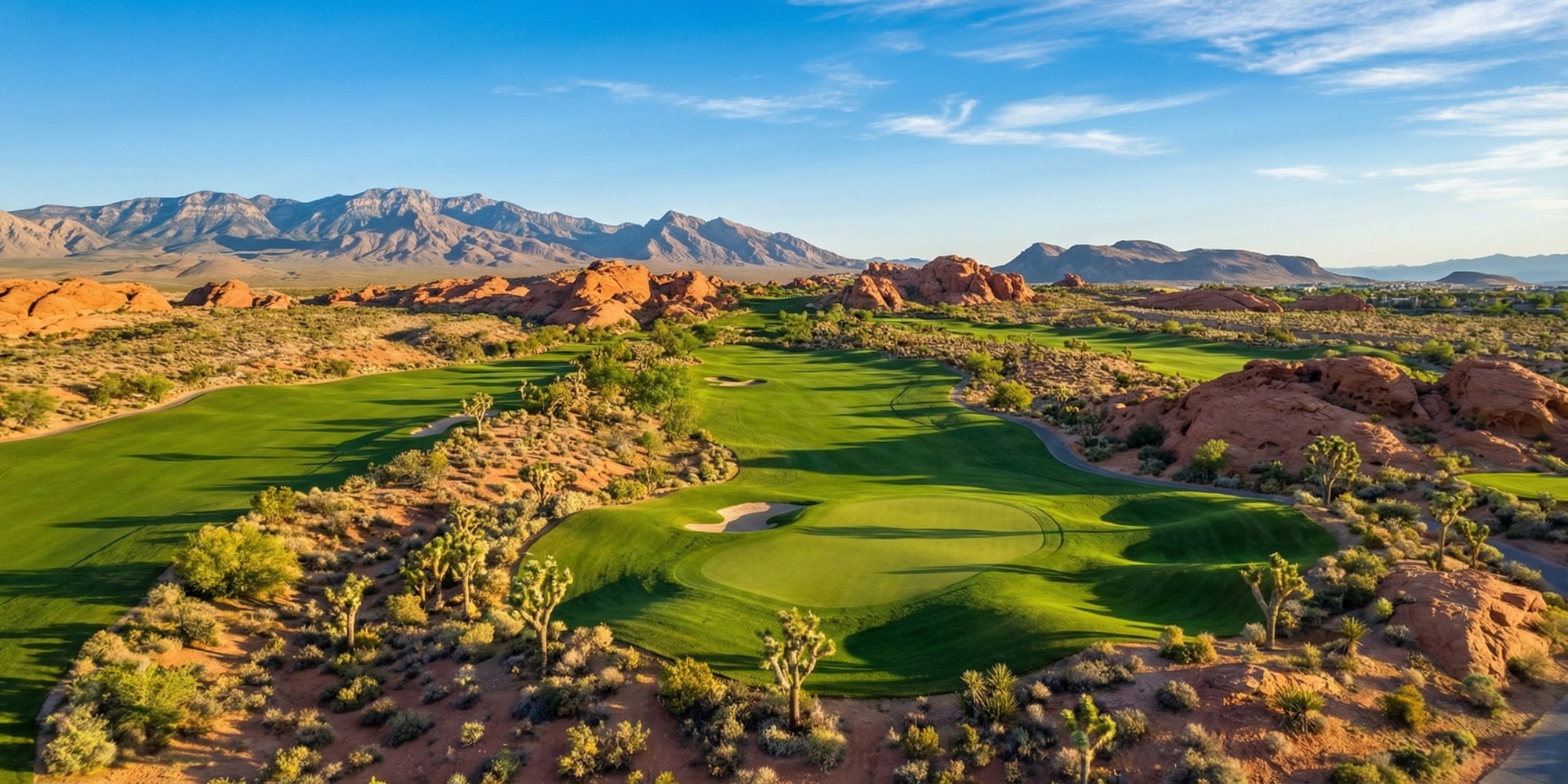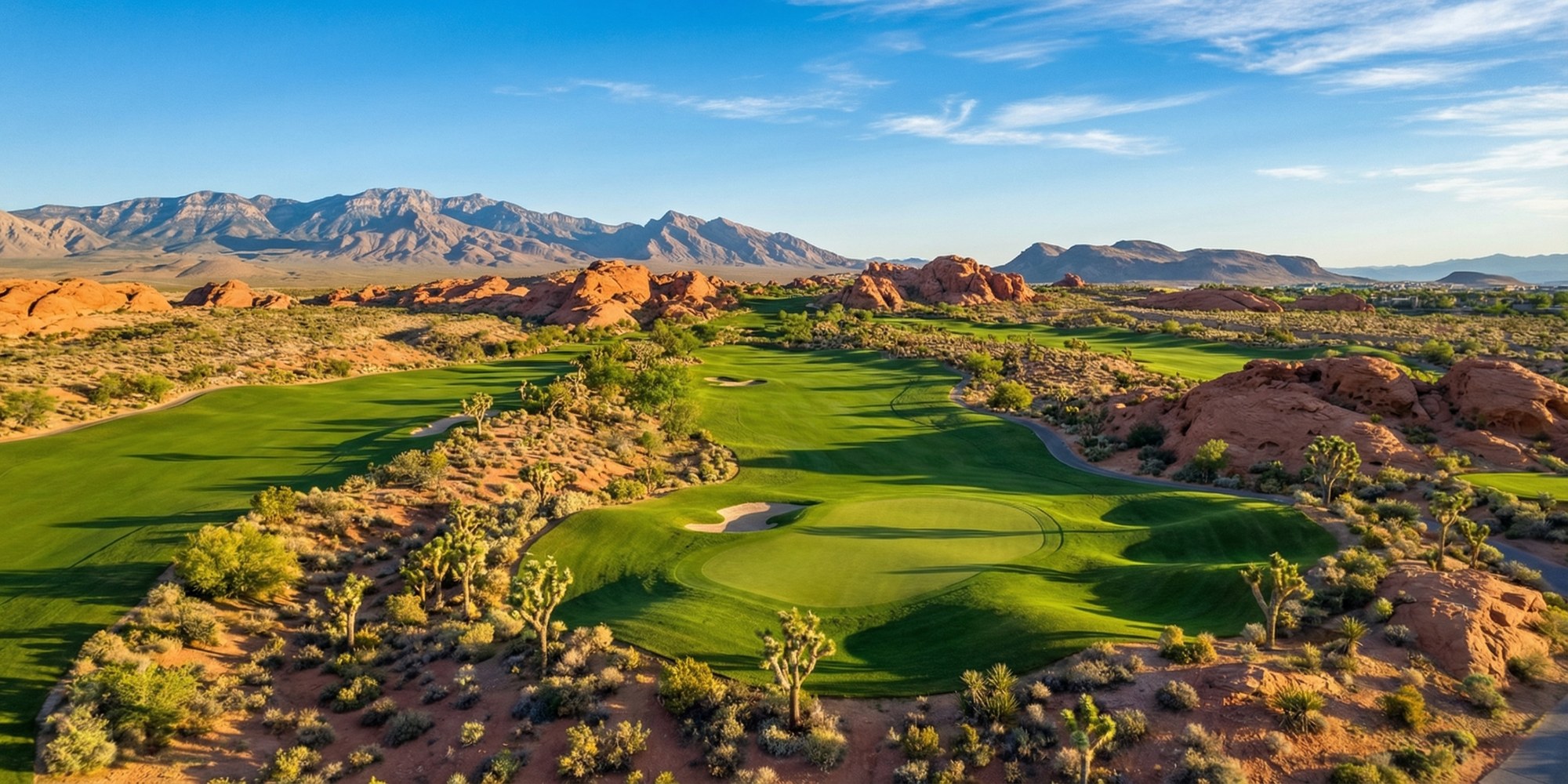
Stand on the 18th tee of Red Rock Country Club's Mountain Course on a clear March morning and the view alone justifies the drive out Charleston Boulevard: the Spring Mountains rise snow-dusted behind the green, Red Rock Canyon's burnt-orange escarpment frames the left rough, and 7,003 yards of Arnold Palmer's desert design unfurls below you in a gradient from deep emerald to desert gold. It is, without argument, the most visually arresting finishing hole in Summerlin — and a fitting conclusion to a course that operates at the highest level of private-club conditioning in the Las Vegas Valley.
Two Courses, One Vision: The Arnold Palmer Legacy at Red Rock
Red Rock Country Club opened in 2001 as a dual-course private facility anchoring the upper reaches of Summerlin, the master-planned community that has become Las Vegas's most prestigious residential address. Both the Mountain Course and the Arroyo Course were conceived by the Arnold Palmer Design Company — the King's design firm at the height of its desert-course output — and together they represent a single coherent philosophy: let the landscape do the heavy lifting, then refine it into championship-caliber strategy.
The two courses share a clubhouse but diverge sharply in character. The Mountain Course climbs into the rocky terrain above the community, using elevation changes of 40 to 60 feet between tee and green to manufacture risk-reward decisions that feel genuinely earned. The Arroyo Course spreads lower, threading through the natural dry washes — arroyos — that carve the Mojave floor, demanding precision off the tee and rewarding golfers who work the ball left-to-right into preferred angles. Playing both in a single day, which members often do via a twilight loop, reveals just how thoughtfully the Palmer team differentiated them.
The Mountain Course: High-Desert Drama at Every Turn
The Mountain Course is the flagship layout, and it earns that billing. From the championship tees at 7,003 yards, par is 72 and the rating reflects a stiff but fair test — the routing presses players into the hillside on the front nine before releasing spectacular panoramic views on the back. Fairways are generous off the tee on most holes, a Palmer hallmark, but the approach corridors tighten as the course climbs, and the greens — running at a consistent 11 to 11.5 on the Stimpmeter during our spring review — demand precision that a strong drive alone cannot substitute.
The signature hole is the par-3 7th, playing 198 yards from the back tee across a rocky ravine to a green perched against the canyon hillside. There is no middle ground here: the shot is either on the putting surface or it is in the desert waste area flanking three sides, with the Spring Mountains forming a backdrop so outsized it genuinely distracts. It is the kind of hole that photographs poorly because no image captures the spatial drama of standing on that tee. The green itself slopes away from the player — a subtle but treacherous false front that will return a conservative approach to the fringe every time — and two bunkers short-left swallow the pulled iron with ruthless efficiency.
Equally compelling is the par-4 18th at 451 yards: a slight dogleg-right that plays uphill to a well-bunkered green with the Spring Mountain escarpment rising directly behind it. The approach must carry a deep front bunker, and the flag position on the upper shelf — the Sunday pin, as members call it — reduces the target to barely 20 feet of usable depth. Members who arrive at the 18th knowing a par wins the match understand exactly what "pressure par" means on this hole.
The Arroyo Course: Desert Garden Precision Golf
At 6,886 yards from the back tees with a par of 72, the Arroyo Course is slightly shorter but no easier — its difficulty is architectural rather than length-based. Where the Mountain Course rewards the powerful hitter who can adjust to elevation, the Arroyo Course is a shot-shaper's exam. The natural washes that give the course its name become lateral hazards on eight holes, and the prevailing wind from the southwest — steady in March, averaging 10 to 15 mph through the afternoon — turns straightforward par-4s into strategic puzzles about which side of the fairway sets up the better angle in.
The course's signature stretch runs from holes 12 through 15, a sequence that plays along the deepest of the natural washes before emerging onto the high plateau of the back-nine finish. The par-5 13th, at 540 yards, offers the round's only genuine birdie opportunity if the drive catches the right slope and the wind cooperates — but an arroyo cutting 30 yards short of the green punishes any second-shot bravado. It is a hole that rewards patience above all else, which is either maddening or meditative depending on your disposition.
Playing Conditions: Course Setup and What to Expect
Both courses were reviewed in early March 2026 under conditions that Summerlin golfers know well: firm, fast Bermudagrass fairways with minimal rough recovery room, creeping bent-grass greens running true and quick, and bunkers refilled with washed white sand that plays predictably out of the face. Green speeds on both courses measured 11 to 11.5 on the Stimpmeter — quick but not tour-speed — and the overall firmness of the fairways rewarded the run-up game that desert golf demands. Rough height was kept at a modest half-inch collar around the greens, with the primary penalty for missed approaches coming from the waste areas and canyon features rather than thick grass.
Pace of play on the Mountain Course was four hours and ten minutes for our foursome — brisk for a course of this complexity, and a direct function of the well-drilled caddies and marshaling that a private operation affords. The Arroyo Course ran five minutes longer given its more complex routing, but never felt slow. These are courses maintained and operated at private-club standards throughout — no short cuts in conditioning, no worn mats on the ranges, no shortcuts anywhere.
Red Rock Country Club has solved the central challenge of desert golf design: how to make the landscape feel like a feature rather than a hazard. Arnold Palmer's team did not fight the Mojave — they choreographed it.
What Sets Red Rock Apart from Other Summerlin Options
Summerlin's golf options span a broad range, from the PGA Tour venue of TPC Summerlin to the more accessible public-access daily-fee layouts. Red Rock Country Club occupies a distinct tier: exclusively private, immaculately conditioned, and situated against a natural backdrop that no course in the valley fully matches. Where TPC Summerlin's primary distinction is its tournament pedigree and Bobby Weed's low-trajectory routing, Red Rock's calling card is the sheer visual and strategic drama of its canyon terrain — and the unhurried, member-exclusive atmosphere that comes with a round here.
The dual-course configuration is also genuinely unusual for a Las Vegas private club. Members who play both courses regularly — rotating between them to avoid the repetition that single-course facilities inevitably produce — benefit from two meaningfully different tests that complement rather than duplicate each other. It is a setup that holds value for the serious golfer who intends to improve, not merely to play.
Who This Club Is Best For — and How to Visit
Red Rock Country Club is a private club, which means access comes through membership or by invitation as a member's guest. The club is woven into the fabric of The Ridges and surrounding upper Summerlin communities, and membership is closely tied to residency and referral. For visiting golfers without a member connection, the honest answer is that this is one to access through the network rather than through the tee sheet — and that access, when it comes, will be worth the effort.
For serious mid- to low-handicap golfers, both courses offer enough strategic depth to hold interest across dozens of rounds. High-handicappers will find the waste areas and canyons punishing in ways that erode the enjoyment of the round — the Arroyo Course in particular demands consistent ball-striking off the tee to keep the ball in play. Corporate outings with a mixed-skill field tend to gravitate toward the Mountain Course, where the wider fairways on the first six holes allow higher handicaps to get into the round before the terrain tightens.
When you do play, arrive 30 minutes early to spend time on the practice facility — the range is extensive, the chipping green representative of the putting surfaces you'll face, and the putting green large enough to warm up for both the pace and slope of the greens. Tee times are arranged through the club at redrockcountryclub.com. There is no finer private golf experience in the Summerlin area, and very few that rival it across the entire Las Vegas Valley.