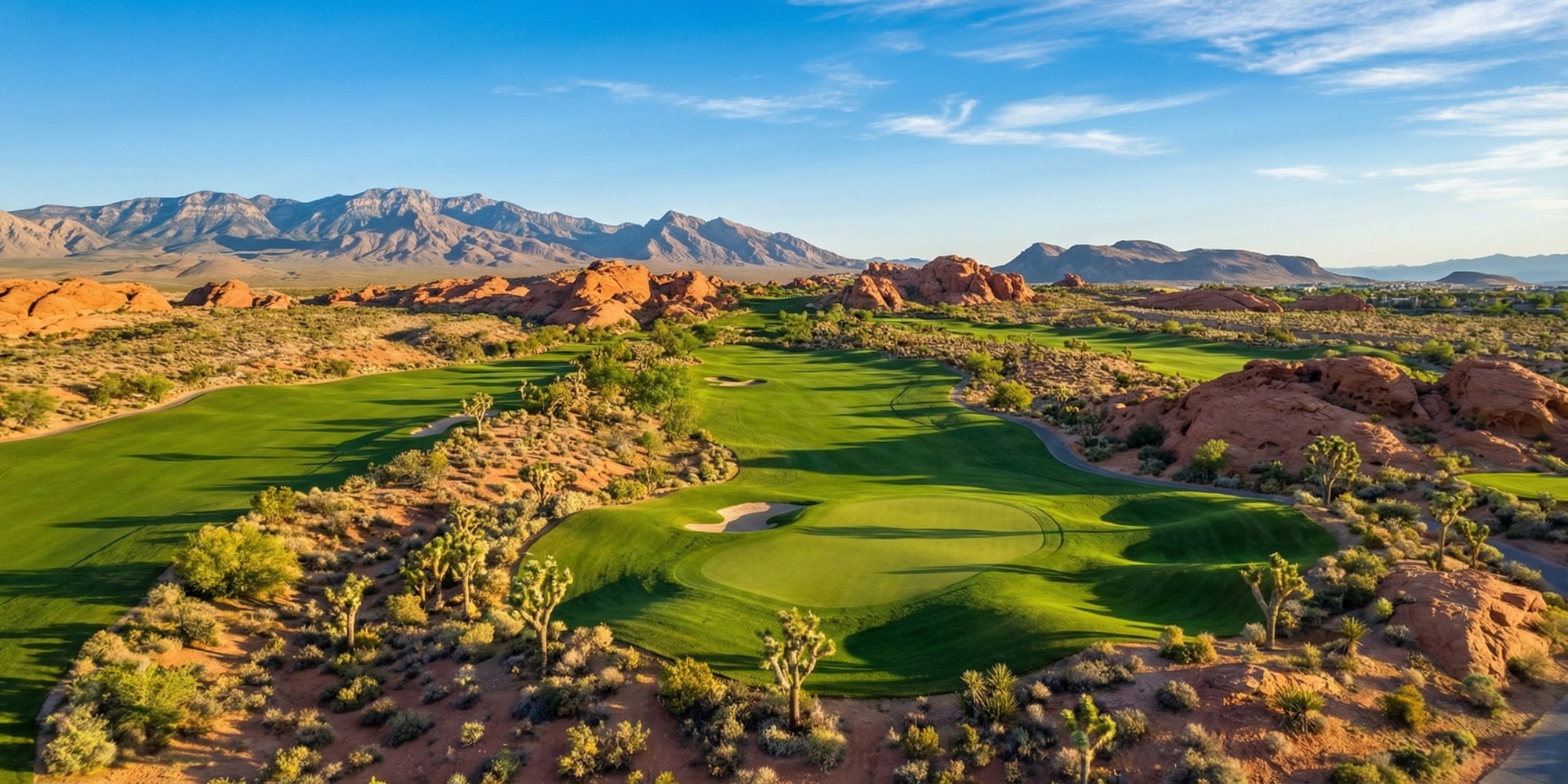
Set against the rust-red silhouette of the Spring Mountains, TPC Summerlin occupies a category of its own among Las Vegas's golf offerings. While the Strip delivers spectacle, TPC Summerlin delivers something rarer: a genuine tournament venue with bent-grass greens rolled to PGA Tour specifications, a layout that has humbled professionals for three decades, and an atmosphere that makes even a casual weekend round feel quietly consequential. This is where the PGA Tour comes to Las Vegas each October — and where discerning golfers come year-round to experience the same course the pros play.
Design Heritage: A Pete Dye Lineage Meets the Mojave
Bobby Weed came to TPC Summerlin as a protégé of the legendary Pete Dye — the architect behind Whistling Straits, TPC Sawgrass, and a handful of the most demanding tournament venues on the planet. Weed absorbed his mentor's genius for strategic bunkering and deceptive visual theater before channeling it into a course calibrated specifically for the Nevada desert. Working alongside Hall of Fame player consultant Raymond Floyd, Weed mapped a routing that plays against the prevailing afternoon wind, positions water as psychological rather than merely penal, and rewards patient, course-management golf over brute power.
When TPC Summerlin opened in 1991, it immediately entered the Tournament Players Club network — a collection of venues owned and operated by the PGA Tour and designed to provide both elite competitive conditions and genuine public access. That dual mandate shapes everything at Summerlin: the bent-grass putting surfaces maintained at tour speed (typically 11–12 on the Stimpmeter during tournament week), the generous but thoughtfully contoured fairways, and the firm-and-fast conditioning philosophy that rewards creative shot-making over aerial bombing.
Thirty-Five Years of Championship History
TPC Summerlin has hosted a PGA Tour event every autumn since its inaugural season — a tenure that makes it one of the most consistently used tour venues in the western United States. The event has evolved through several naming iterations: from the Las Vegas Invitational through the Justin Timberlake Shriners Hospitals for Children Open to its current identity as the Shriners Children's Open. Through every rebrand, the course has remained constant, its low-scoring birdie-fest reputation intact.
The tournament regularly produces some of the most dramatic finishes on the fall portion of the PGA Tour schedule. Scores in the mid-to-low 20s under par are common on the leaderboard, a testament to both the scoring-friendly desert air and Weed's design philosophy of accessible challenge — the course bites back precisely when competitors grow overconfident. Past champions who have lifted the trophy here include a distinguished roster of PGA Tour winners, many at early career stages that foreshadowed long careers at the top of the game.
There's nowhere quite like TPC Summerlin in October — the desert light turns the fairways an impossible shade of green, the greens are running true at 11-plus, and the crowd energy has something electric about it that the scoreboards alone can't explain.
Signature Holes: Where the Course Reveals Its Character
TPC Summerlin is a par-71 layout — unusual for a championship venue — and that single-par deviation shapes the entire round. The course plays two par-5s and five par-3s, creating a rhythm that alternates between scoring opportunities and precision demands unlike almost any other PGA Tour stop.
The 16th, a 166-yard par-3, is the course's most photographed and most feared hole. From the tee, the green appears virtually surrounded by water on three sides, demanding a carry that allows almost no margin for error on the short or right side. During tournament week, pin positions on the 16th have decided championships — a birdie here is enormously satisfying; a mishit is catastrophic. For recreational players, the multiple tee positions bring the carry distance to a manageable range, but the green's slight raised contour and the shimmering lake to the right ensure the adrenaline never fully subsides.
The 17th hole, a 451-yard par-4, plays as one of the most demanding driving holes on the property. A right-to-left dogleg rewards a drawn tee shot down the left side, but players who overcook the draw find a penalty area that frames the entire left boundary. The approach demands precise club selection — the green is shallower than it appears from the fairway — and two-putting from the back tier is a genuine achievement at any playing speed.
The 9th, a 598-yard par-5, is the course's most generous birdie opportunity and the pivot point of any good front-nine score. The hole plays downwind in the prevailing afternoon breeze, making it reachable in two for the longer hitter, but a series of sand bunkers right of the green punishes the aggressive approach that misses its mark. This hole is where course management separates the confident from the careless.
Amenities, Facilities, and the TPC Experience
TPC Summerlin's clubhouse is precisely what you'd expect from a PGA Tour property — refined without being ostentatious, functional without sacrificing elegance. The pro shop carries a thoughtfully curated selection of apparel and equipment, and the staff maintains the knowledgeable, low-key professionalism that distinguishes a genuine golf club from a resort with a tee sheet. The practice facility includes a full driving range, short-game area, and putting green maintained to the same bent-grass standard as the course itself — an increasingly rare luxury that allows for meaningful pre-round preparation rather than a perfunctory warm-up on synthetic grass.
Dining options in and around the clubhouse cater to the post-round debrief: a welcoming 19th-hole atmosphere where a cold beer and a plate of something satisfying arrive without ceremony. For those interested in the community surrounding the course, Summerlin — the master-planned community that frames TPC's western boundary — offers a broader ecosystem of world-class restaurants, luxury retail, and residential neighborhoods that count proximity to the course as a defining amenity. The Tournament Hills neighborhood immediately adjacent to TPC Summerlin is among Las Vegas's most sought-after golf-access addresses.
Planning Your Round: Booking, Best Times, and Visitor Tips
TPC Summerlin operates as a semi-private facility, with tee times available to the public through the official TPC booking portal. Green fees vary meaningfully by season: the spring window (March through May) and the fall tournament shoulder season (September–October) represent peak pricing, while the summer months — when desert heat sends daytime temperatures into triple digits — offer significantly reduced rates for golfers willing to tee off at dawn. Winter mornings in Summerlin are often ideal: cool, dry, and uncrowded, with the Spring Mountains occasionally dusted with snow providing a backdrop that photographs as well as it plays.
A few tips for first-time visitors: book the earliest available tee time to play in the sharpest morning light and coolest conditions; bring at least two balls for the 16th green (the lake claims its share); and take a moment on the 18th tee to look back west toward the red rock formations of the Spring Mountains — it's the kind of vista that reminds you why Summerlin occupies such a singular place in American golf geography. For more on the surrounding community and additional Summerlin golf courses, explore our complete guide to the area's finest layouts. TPC Summerlin isn't just the best course in Las Vegas — it's one of the best public-access championship venues in the American West, and it plays to that standard every single day the gates open.