Palm Valley Golf Club Reviewed: Golf Summerlin's Championship Flagship — Big Bunkers, Bigger Views
The oldest and longest of Golf Summerlin's three Billy Casper–Greg Nash designs delivers a true par-72 challenge with 68 bunkers, a punishing closing stretch, and all the unpretentious value Las Vegas locals love.
Course at a Glance
Stand on the tee box of the 18th hole at Palm Valley Golf Club and you'll understand immediately why regulars call this the most honest finishing hole in the Las Vegas Valley. The fairway stretches 534 yards ahead of you before bending sharply right — water pressing in from the moment the dogleg unfolds, out-of-bounds stakes marking the left, and a bunker-ringed green sitting in calm indifference to whatever chaos precedes it. Par five. Good luck. This is how Palm Valley Golf Club says hello to its closing stretch, and it's precisely this kind of well-engineered consequence that has kept Las Vegas golfers coming back to Sun City Summerlin's flagship course since 1989.
The Course That Started It All
Palm Valley is the founding course of Golf Summerlin's three-course campus — the first layout Billy Casper and Greg Nash delivered to Sun City Summerlin when the master-planned active adult community broke ground on its western Las Vegas Valley acreage. The year was 1989. Sun City Summerlin was still taking shape across 7,779 eventual home sites, and golf was the organizing principle from the start. The community owns and operates its courses directly — a model that remains unusual in Las Vegas and explains a great deal about the consistently excellent conditions at Palm Valley. When residents' property values are tied to golf quality, maintenance standards don't slip.
The course plays to a par 72 from the back Blue tees at 6,706 yards, with a Course Rating of 71.7 and a Slope of 127 — numbers that tell an honest story: this is a genuine championship test, accessible enough for mid-handicappers who respect the layout, demanding enough to challenge single-digits who think they know better. Three additional tee sets bring the course in at 6,242 yards (White), 5,741 yards (Gold), and 5,425 yards (Red), giving every level of player a fair contest.
Playing the Layout — A Course That Demands Every Club
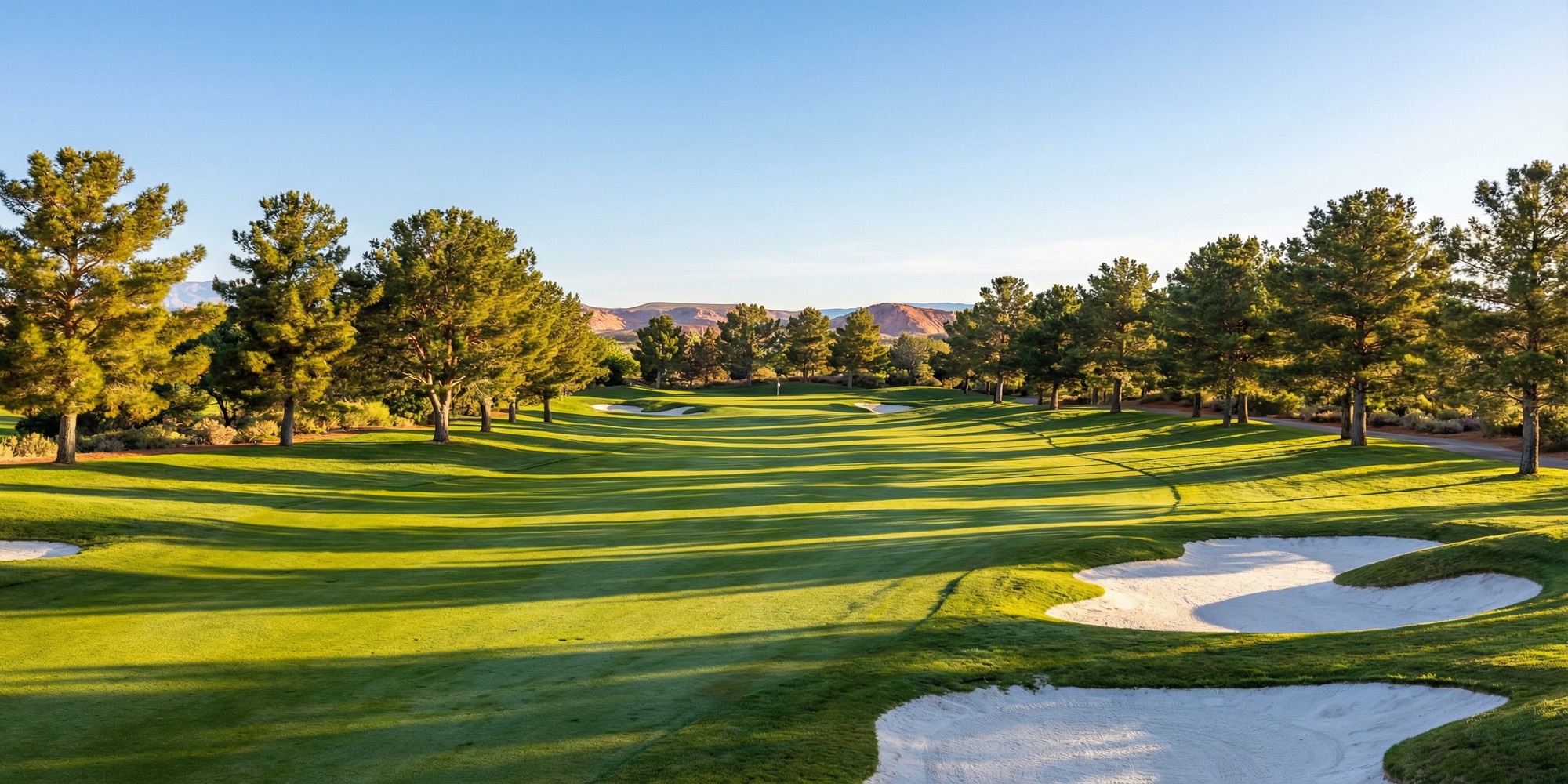
What separates Palm Valley from the rest of Summerlin's public offerings isn't drama — there are no Red Rock Canyon escarpments framing the skyline here. What you get instead is architecture: 68 bunkers placed with genuine strategic intent, mature pine trees lining fairways in a way that feels almost transplanted from a Carolina layout, bentgrass greens that hold speed and break cleanly through Las Vegas's spring season, and Bermuda fairways that are fully greened up by April and playing firm-to-medium. The result is a course that rewards positioning off the tee and punishes the golfer who reaches for driver when an iron would serve better.
The par-5s set the rhythm: the opening hole (537 yards) immediately tests whether you'll play conservatively or attack a bunker-guarded green in two. Hole 4 (483 yards) offers a reachable risk-reward par-5 with water threatening the approach. The longest par-4 on the card — Hole 5 at 454 yards — demands a precise drive into a tightened landing zone before a demanding approach to a well-protected green. The variety is the point: Palm Valley cycles through strategic puzzles rather than relying on a single theatrical feature to justify its existence.

The Closing Stretch: Holes 16, 17, and 18
If Palm Valley has a calling card, it's the final three holes — a gauntlet that distills everything the course is about into consecutive tests of precision, nerve, and clean ball-striking.
Hole 16 is a par-3 at 229 yards that plays as one of the hardest single holes among all Golf Summerlin's three courses. There is no layup option. The green is elevated and guarded by bunkers left and a severe drop-off right. You're hitting a long iron or fairway wood at a green that will return anything short or off-center with contempt. Miss in the right place and you're chipping uphill; miss in the wrong place and you're scrambling.
Hole 17 (par-4, 415 yards) offers a momentary breath — demanding accuracy but forgiving enough in design to let a good drive set up a manageable approach. Then comes 18.
"One of the top 10 finishing holes in Las Vegas." — Shane Sanchez, Head Professional, Palm Valley Golf Club
The 534-yard par-5 closer presents the course's purest expression of risk and consequence: a 90-degree dogleg right with water guarding the entire second half of the hole's right side, out-of-bounds left, and a bunker-ringed green that leaves no room for imprecision on the approach. Big hitters who carry the corner can reach in two, but the penalties for misjudging are immediate and expensive. For a public course at this price tier, it's a genuinely memorable finishing experience — the kind of hole you replay on the drive home.
Palm Valley vs. the Summerlin Field
Context matters when evaluating Palm Valley, because Summerlin offers one of the most varied public golf landscapes in the American Southwest. The honest comparison goes like this: Highland Falls Golf Course delivers more elevation drama and panoramic views from its Sun City Summerlin hillside terrain — but Palm Valley is the stronger scoring test with tighter architecture. TPC Summerlin is tour-caliber and commands tour-level pricing; Palm Valley delivers roughly 75% of the challenge at 25–30% of the cost, making it the rational choice for golfers who want championship conditions on a local-public budget.
Bear's Best Las Vegas — the Jack Nicklaus tribute course that once competed for the best-value championship crown in Summerlin — closed to public play in June 2025 when it transitioned to a private model. That shift leaves Palm Valley as the clear front-runner among Summerlin's fully public championship options. Angel Park's two courses offer strong competition at a similar price tier, but Palm Valley's bunker architecture and strategic variety give it an edge for golfers who value layout sophistication over pure visual spectacle. See our Summerlin golf courses guide for a full side-by-side comparison.
Who is this course best for? Mid- to low-handicappers who want a genuine challenge without the private-club price tag. Las Vegas residents who play regularly and want a consistent, well-maintained track that rewards repeated rounds and course knowledge. Corporate and group outing organizers — the catering packages and 18-hole layout support large groups effectively. Not the pick for true beginners or golfers who prioritize dramatic desert scenery above all else.
Visitor's Guide: How to Play Palm Valley
April is prime time at Palm Valley. Spring temperatures in the Las Vegas Valley typically run between 70°F and 85°F, Bermuda fairways are fully transitioned from winter overseeding, and bentgrass greens are holding speed and consistent break. Morning tee times move briskly — Sun City Summerlin's resident golfer culture tends toward efficiency. Afternoon rounds slow slightly as the temperatures climb and visitor traffic increases.
Dynamic pricing means the $63–$207 green fee range reflects demand-based fluctuation. Booking early online through golfsummerlin.com or via GolfNow typically secures the best rates. Cart is included. For those planning a multi-course trip, club pricing across all three Golf Summerlin courses (Palm Valley, Highland Falls, and Eagle Crest) incentivizes pairing rounds — the combination of Palm Valley's full championship test with Highland Falls's scenic hillside layout makes for an exceptional two-course day.
Post-round, the Five Star Tavern clubhouse is a study in unpretentious Las Vegas charm: casual dining, a well-stocked bar, slot machines and video poker at the counter (quintessentially Nevada), and a patio overlooking the 18th green where you can dissect your scorecard over something cold. The staff know regulars by name. It is, in the best possible sense, a neighborhood golf club — one that happens to offer a championship course.
Palm Valley Golf Club sits at 9201 Del Webb Blvd, Las Vegas, NV 89134. Group outing reservations: 702-363-2617. Additional information through suncitysummerlingolf.com.
Find Palm Valley Golf Club
9201 Del Webb Blvd, Las Vegas, NV 89134